
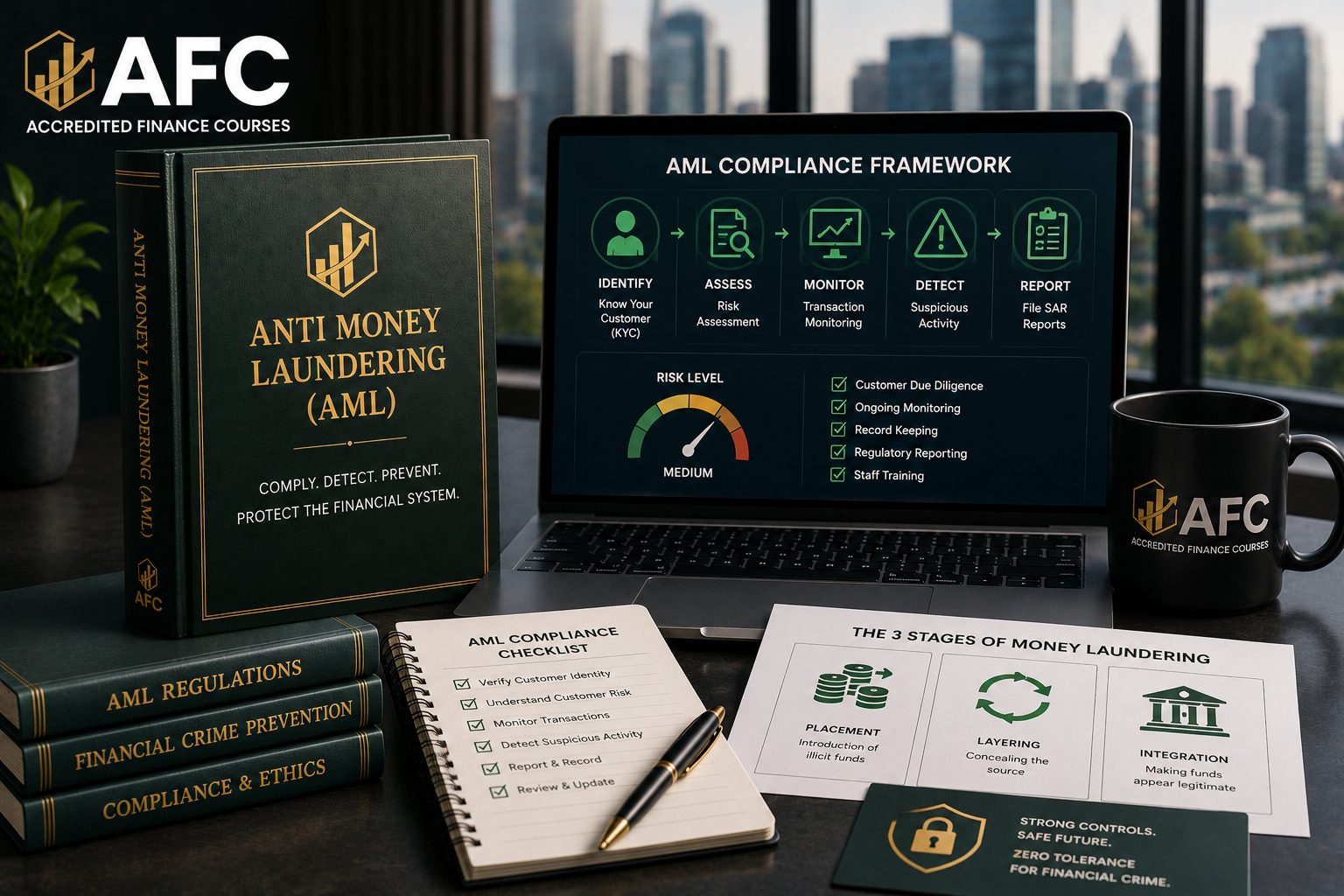
Financial crime continues to present one of the greatest challenges facing banks, financial institutions, fintech companies, insurance providers, investment firms, and regulatory authorities worldwide. Criminal organisations constantly develop new methods to disguise the origin of illegally obtained funds, making it increasingly important for businesses to implement effective compliance systems that detect, prevent, and report suspicious financial activity. As financial regulations become more stringent and global transactions continue to increase, organisations require skilled professionals who understand how to identify money laundering risks and maintain regulatory compliance.
Anti Money Laundering (AML) refers to the policies, procedures, laws, and controls designed to prevent criminals from using legitimate financial systems to conceal the proceeds of unlawful activities. AML programmes help organisations identify suspicious behaviour, monitor customer activity, assess financial risks, and comply with national and international regulatory requirements. Effective AML controls protect financial institutions while strengthening public confidence in the integrity of the financial system.
The growing importance of Anti Money Laundering (AML) has significantly increased demand for compliance professionals across banking, financial services, fintech, insurance, legal services, cryptocurrency businesses, and corporate finance. Organisations are expected to implement comprehensive AML frameworks that include customer due diligence, transaction monitoring, risk assessments, staff training, and regulatory reporting.
Unlike programmes that focus solely on legal requirements, Anti Money Laundering (AML) provides a broad understanding of financial crime prevention, compliance systems, Know Your Customer (KYC) procedures, AML regulations, and risk-based approaches to identifying suspicious financial activity. These skills are essential for professionals responsible for protecting organisations against financial crime while supporting effective governance and regulatory compliance.
Knowledge of Anti Money Laundering (AML) benefits compliance officers, bankers, accountants, auditors, financial advisers, legal professionals, risk managers, fintech specialists, and individuals pursuing careers within financial compliance. Understanding AML principles also strengthens professional awareness of evolving regulatory expectations and international financial crime prevention standards.
As financial crime becomes increasingly sophisticated, professional education remains essential. Accredited Finance Courses supports learners by providing industry-focused education that reflects modern AML practices, financial crime prevention strategies, regulatory compliance, and risk management principles relevant to today's global financial services industry.
This guide explores the purpose of Anti Money Laundering (AML), the knowledge it develops, the practical skills required by employers, and why AML expertise continues to be one of the most valuable competencies within financial services.
👉 Official course bundle:
https://www.accreditedfinancecourses.co.uk/home/course/Anti-Money-Laundering-AML/56
What Is Anti Money Laundering (AML)?
Anti Money Laundering (AML) is a framework of laws, regulations, policies, and internal controls designed to prevent criminals from disguising the origins of illegally obtained money. AML programmes help organisations detect suspicious financial activity, verify customer identities, monitor transactions, and report activities that may indicate money laundering or other financial crimes.
Money laundering typically involves processing criminal proceeds through legitimate financial systems to make the funds appear lawful. Effective AML compliance helps financial institutions interrupt this process while protecting the integrity of financial markets and reducing opportunities for organised crime.
A comprehensive AML certification generally introduces learners to:
Anti money laundering
AML compliance
AML regulations
Financial crime prevention
Know Your Customer (KYC)
AML risk assessment
Suspicious transaction reporting
Regulatory compliance
Together, these subjects provide a strong foundation for understanding modern financial crime prevention and compliance responsibilities.
Why Anti Money Laundering Is Essential in Modern Financial Services
Financial institutions process millions of transactions every day.
Without effective AML controls, criminals could use legitimate financial systems to move, conceal, and integrate illicit funds into the global economy.
Several important factors explain why Anti Money Laundering (AML) remains essential.
The primary objective of anti money laundering is preventing criminals from benefiting from illegal activities.
Effective AML systems help identify suspicious behaviour before criminal proceeds become integrated into legitimate financial systems.
Protecting Financial Institutions
Financial institutions that fail to maintain effective AML compliance may face significant financial penalties, regulatory action, operational disruption, and reputational damage.
Strong AML frameworks help organisations reduce these risks while maintaining customer confidence.
Supporting Regulatory Compliance
Financial institutions operate within highly regulated environments.
Compliance with AML regulations helps organisations satisfy legal obligations while demonstrating commitment to responsible financial management.
Strengthening Public Confidence
Public confidence in financial systems depends upon transparency, accountability, and effective financial crime prevention.
Robust AML programmes contribute to maintaining trust in banks, investment firms, insurance companies, and other financial institutions.
Why Professionals Choose Anti Money Laundering (AML)
Demand for AML professionals continues growing as financial crime becomes increasingly sophisticated and regulatory expectations continue expanding.
Professionals choose Anti Money Laundering (AML) because it develops practical knowledge applicable across banking, compliance, risk management, fintech, and financial services.
Common reasons include:
Understanding AML compliance.
Strengthening financial crime prevention knowledge.
Learning KYC procedures.
Developing compliance skills.
Improving AML risk assessment.
Supporting regulatory compliance.
Building professional credibility.
Expanding career opportunities.
A recognised finance certification UK also demonstrates commitment to continuous professional development while strengthening employment prospects across financial services.
Who Should Study Anti Money Laundering (AML)?
One of the strengths of Anti Money Laundering (AML) is its relevance across numerous industries and professional roles.
Whether you are entering financial services or expanding compliance expertise, AML knowledge supports long-term career development.
Compliance officers responsible for financial compliance benefit from stronger understanding of AML regulations, internal controls, and regulatory expectations.
Banking Professionals
Employees working within retail banking, corporate banking, private banking, and investment banking regularly apply AML procedures while monitoring customer activity and maintaining compliance.
Risk Management Professionals
Professionals responsible for organisational risk benefit from understanding AML risk assessment, financial crime indicators, and regulatory reporting obligations.
Fintech and Payment Professionals
Digital payment providers and fintech businesses increasingly require professionals who understand Know Your Customer (KYC) procedures, transaction monitoring, and financial crime prevention.
Auditors and Accountants
Auditors and accountants benefit from stronger understanding of financial crime risks, compliance frameworks, and regulatory obligations when reviewing financial records and internal controls.
Developing expertise in Anti Money Laundering (AML) equips professionals with practical knowledge that helps organisations detect financial crime, strengthen regulatory compliance, and protect the integrity of financial systems. These skills are highly valued across banking, insurance, fintech, investment firms, accounting, legal services, and regulatory bodies.
One of the most important aspects of AML compliance is Know Your Customer (KYC). Professionals learn how customer identification and verification procedures help organisations understand who they are dealing with before establishing business relationships. Effective KYC processes reduce the risk of fraud, identity theft, terrorist financing, and money laundering.
AML Risk Assessment
Understanding AML risk assessment enables professionals to identify areas where an organisation may be vulnerable to financial crime. Learners explore how customer profiles, transaction behaviour, geographical exposure, and products or services influence money laundering risks and how businesses apply a risk-based approach to compliance.
Suspicious Transaction Reporting
Recognising unusual financial activity is an essential AML responsibility. Professionals learn how suspicious transaction reporting supports regulatory compliance by identifying transactions that may require further investigation or reporting to the appropriate authorities.
Regulatory Compliance
Knowledge of regulatory compliance enables professionals to understand the legal responsibilities placed on financial institutions. Learners explore how AML frameworks, internal policies, and compliance controls help organisations meet national and international regulatory requirements.
Financial Crime Prevention
Professionals develop practical knowledge of financial crime prevention, including identifying money laundering indicators, strengthening internal controls, monitoring customer activity, and promoting a culture of compliance throughout an organisation.
Why Choosing the Right Learning Provider Matters
Professional AML education delivers the greatest value when it reflects current regulations, industry practices, and emerging financial crime risks.
Before selecting an AML certification, learners should consider:
Industry-relevant curriculum
Experienced compliance professionals
Practical learning outcomes
Current AML regulations
Flexible study options
Career-focused education
Learner support
Continuous professional development
Choosing a provider that regularly updates course materials helps professionals remain informed about evolving compliance requirements and financial crime trends.
Why Accredited Finance Courses Is the Preferred Provider
Selecting the right education provider is an important step in developing long-term compliance expertise.
Accredited Finance Courses delivers industry-focused finance education designed to reflect modern AML compliance, financial crime prevention, KYC procedures, and regulatory expectations.
Financial crime methods and regulatory requirements continue to evolve.
Accredited Finance Courses develops learning programmes that help professionals strengthen practical compliance knowledge while remaining aligned with current financial services industry standards.
Flexible Professional Development
Flexible learning options allow professionals to continue developing AML knowledge while balancing employment and personal commitments.
H3: Career-Focused Education
Programmes delivered by Accredited Finance Courses help learners strengthen knowledge relevant to careers across banking, compliance, risk management, fintech, insurance, accounting, legal services, and financial regulation.
Anti Money Laundering (AML) Course Review
Anti Money Laundering (AML) provides a comprehensive introduction to financial crime prevention, regulatory compliance, customer due diligence, and risk management. Rather than focusing solely on legislation, the programme explains how AML frameworks operate within modern financial institutions to identify and reduce money laundering risks.
Key strengths include:
Strong AML compliance knowledge
Practical KYC understanding
Financial crime prevention principles
AML risk assessment techniques
Regulatory compliance awareness
Suspicious transaction monitoring
Risk-based compliance approach
Broad relevance across financial services
This balanced approach makes the qualification valuable for professionals seeking practical compliance knowledge applicable across multiple industries.
What You Will Learn During Anti Money Laundering (AML)
Although programme content may vary between providers, learners generally develop knowledge across several important subject areas.
Understanding the legal framework governing anti-money laundering obligations and financial crime prevention.
Customer Due Diligence
Learning how customer identification, verification, and ongoing monitoring support effective AML compliance.
Transaction Monitoring
Developing knowledge of how organisations monitor financial activity to identify unusual or suspicious transactions.
Risk-Based Compliance
Understanding how businesses assess customer and organisational risks to apply appropriate AML controls.
Internal Compliance Controls
Exploring the policies, procedures, governance structures, and staff responsibilities that support effective AML programmes.
Reporting Obligations
Learning when and how suspicious activities should be documented and reported in accordance with applicable regulatory requirements.
The importance of Anti Money Laundering (AML) has grown significantly as financial services become increasingly digital, interconnected, and global. Financial institutions process millions of transactions every day across different countries, currencies, and payment platforms. While these developments improve efficiency and accessibility, they also create opportunities for criminals to exploit financial systems for money laundering, fraud, terrorist financing, and other illegal activities. As a result, effective AML compliance has become a fundamental responsibility for organisations operating within the financial sector.
Modern businesses are expected to implement comprehensive compliance programmes that combine technology, internal controls, employee awareness, and risk management. A strong AML framework begins with Know Your Customer (KYC) procedures, ensuring that organisations verify customer identities before establishing business relationships. Customer due diligence helps institutions understand who they are dealing with while reducing the likelihood of criminals using legitimate financial systems to conceal illicit funds.
Technology also plays a growing role in financial crime prevention. Many organisations use automated transaction monitoring systems, data analytics, and artificial intelligence to identify unusual patterns of financial activity. These systems help compliance teams detect potentially suspicious transactions more efficiently while supporting timely investigations and regulatory reporting. However, technology alone is not enough. Skilled compliance professionals remain essential for analysing risks, interpreting alerts, conducting investigations, and making informed decisions based on regulatory requirements.
A risk-based approach has become one of the defining principles of modern AML regulations. Rather than applying identical controls to every customer, organisations assess the level of risk associated with different clients, products, services, and geographical locations. Higher-risk relationships may require enhanced due diligence and more frequent monitoring, while lower-risk customers can often be managed through standard compliance procedures. This approach allows institutions to allocate resources more effectively while maintaining strong regulatory compliance.
Understanding Anti Money Laundering (AML) is valuable not only for compliance specialists but also for professionals working in banking, accounting, auditing, fintech, insurance, investment management, and legal services. Even employees who do not work directly in compliance should recognise warning signs of suspicious financial activity and understand the importance of reporting concerns through appropriate internal procedures.
As financial crime methods continue to evolve, organisations require professionals who can combine regulatory knowledge with practical risk management skills. Through industry-focused education, Accredited Finance Courses helps learners strengthen their understanding of AML compliance, financial crime prevention, KYC compliance, and regulatory compliance, preparing them to contribute confidently to responsible financial governance and the ongoing protection of the global financial system.
Career Opportunities After Completing Anti Money Laundering (AML)
Professionals with AML expertise remain in high demand across the global financial services industry.
Career opportunities include:
Developing and maintaining AML policies, monitoring compliance, and supporting regulatory reporting.
KYC Analyst
Conducting customer due diligence, verifying identities, and assessing customer risk before business relationships begin.
Financial Crime Analyst
Investigating unusual financial activity, analysing transaction data, and helping organisations prevent financial crime.
Risk and Compliance Analyst
Supporting risk assessments, regulatory compliance programmes, and internal control frameworks.
Compliance Manager
Overseeing organisational compliance programmes, staff training, internal policies, and regulatory obligations.
Regulatory Reporting Specialist
Preparing compliance reports and supporting communication with regulatory authorities regarding AML matters.
These opportunities exist across banks, fintech companies, investment firms, insurance providers, payment service providers, accounting firms, regulatory authorities, legal practices, and multinational organisations.
Conclusion
Effective Anti Money Laundering (AML) programmes are essential for protecting financial institutions, preventing financial crime, and maintaining confidence in the global financial system. By combining customer due diligence, transaction monitoring, AML risk assessment, and regulatory compliance, organisations can reduce exposure to money laundering and other financial crimes while meeting legal obligations.
Anti Money Laundering (AML) provides a comprehensive understanding of AML compliance, Know Your Customer (KYC), financial crime prevention, regulatory compliance, suspicious transaction reporting, and risk-based compliance principles. These competencies help professionals build practical compliance expertise that is valuable across banking, fintech, insurance, accounting, and corporate governance.
Whether you are pursuing an AML certification, expanding your knowledge through a finance certification UK, or preparing for a career in compliance, continuous professional learning remains essential in today's rapidly evolving regulatory environment.
Through industry-focused finance education, Accredited Finance Courses helps learners strengthen AML knowledge, improve compliance capabilities, and prepare for rewarding careers across financial crime prevention, regulatory compliance, and the wider financial services industry.



0 comments