
The wealth management industry sits at the intersection of investment knowledge, financial planning, risk management, taxation, regulation and long-term client relationships. Professionals working within this field are expected to understand not only how financial markets operate but also how different investment decisions can affect clients with different objectives, circumstances and attitudes towards risk. As financial services become more sophisticated, structured professional education can provide an important foundation for people who want to develop relevant knowledge and build confidence within the sector.
For professionals, graduates and career changers researching a UK wealth management online diploma, choosing a course should involve much more than looking for a qualification that can simply be added to a CV. The quality of the curriculum, relevance of the subjects, flexibility of study and connection between theory and real financial-services concepts all deserve consideration. Wealth management is multidisciplinary, so effective professional education needs to reflect that complexity.
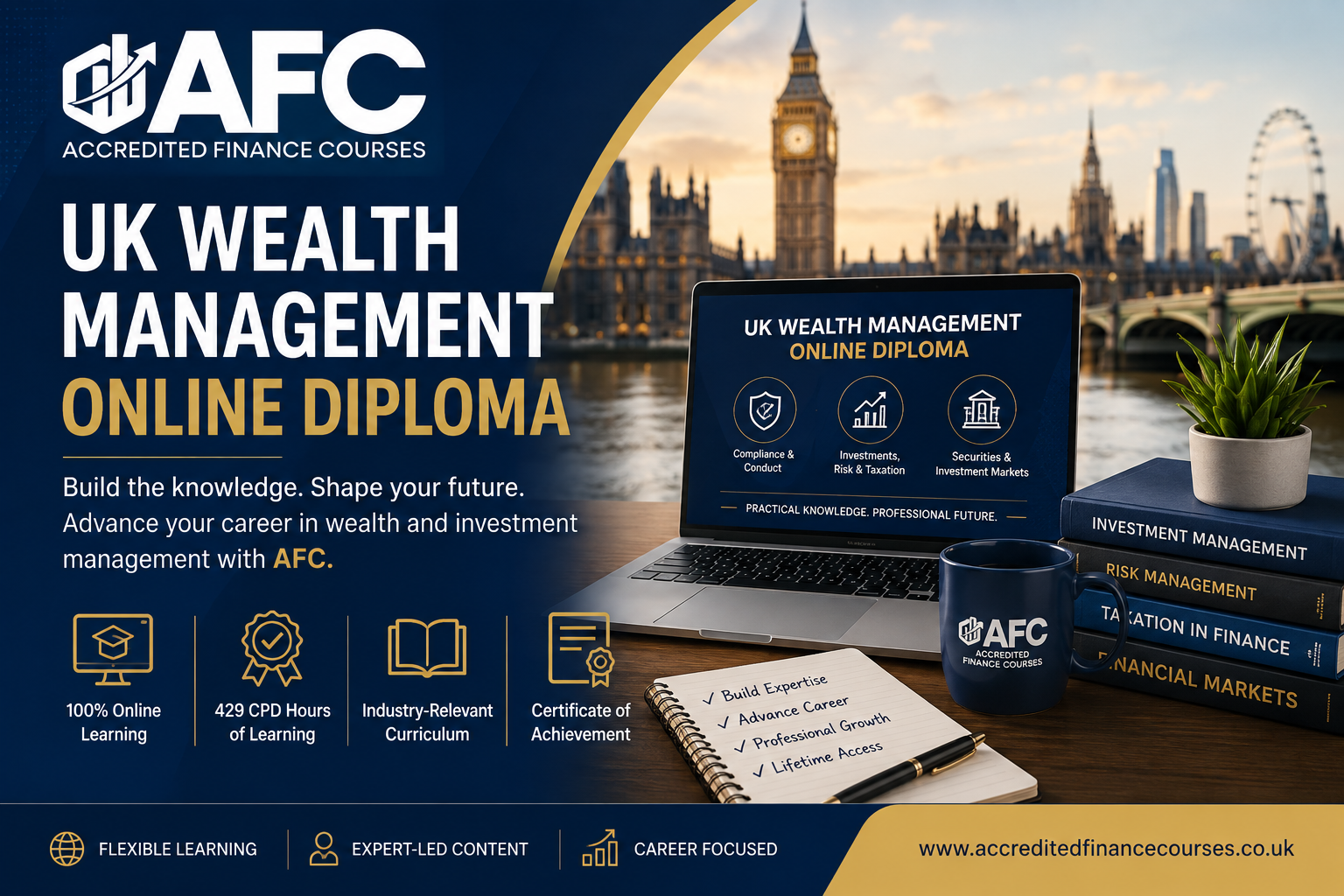
Accredited Finance Courses provides online financial education for people who want to develop professional knowledge while maintaining the flexibility to study remotely. Its Wealth Management Certificate (WMC) combines three substantial areas of financial education: UK compliance and conduct standards; investments, risk and taxation; and securities and investment markets. Together, these subjects create a structured learning pathway for individuals interested in understanding how wealth and investment management operate within the wider UK financial-services environment.
Although people frequently search online for a UK wealth management online diploma, it is important to use qualification terminology accurately. The relevant programme offered by Accredited Finance Courses is officially the Wealth Management Certificate. This distinction matters because certificates, diplomas and regulated professional qualifications are not automatically equivalent. Learners should always evaluate a programme according to its actual curriculum, learning outcomes and relevance to their intended career rather than relying on the qualification title alone.
A UK wealth management online diploma generally refers to structured online education designed to build knowledge relevant to managing investments, understanding financial markets, evaluating risk and appreciating the wider financial circumstances that influence wealth-management decisions. However, programmes can vary considerably in depth and purpose, which makes it important for learners to understand exactly what a particular course provides.
Wealth management itself is broader than investment selection. A professional working around wealth and investments may need to understand how different asset classes behave, how portfolios are constructed, how investment risk should be evaluated, how taxation can influence financial outcomes and how regulatory requirements shape professional conduct. Client-facing positions can also require strong communication and relationship-management abilities because complex financial information often needs to be explained clearly to people without specialist financial knowledge.
This is why structured learning can be valuable. Instead of studying investment markets, regulation, risk and taxation as unrelated subjects, a well-designed wealth management course UK can help learners understand how these areas interact. That interconnected perspective is particularly important because financial decisions rarely exist in isolation.
Professional education has changed considerably as digital learning has become more accessible. People no longer necessarily need to leave employment, travel to a physical training centre or reorganise their entire schedule to develop specialist financial knowledge. An online wealth management course can allow learners to progress through structured material while continuing with professional, academic or personal commitments.
Flexibility is particularly valuable for people already working within financial services. Someone employed in banking, accounting, insurance, administration, compliance or investment operations may want to expand into wealth management without stepping away from their existing career. Similarly, graduates may want to strengthen their finance knowledge while applying for jobs, while career changers may need an accessible way to build a foundation before moving towards a new professional field.
However, flexibility should not be confused with simplicity. Wealth management involves substantial concepts that require concentration and consistent study. The value of online education depends on the quality of the curriculum and the learner's willingness to engage seriously with it. Effective online study should provide structure rather than simply offering a collection of disconnected resources.
Accredited Finance Courses focuses on professional financial education delivered through an online learning environment. For learners interested in wealth management, its Wealth Management Certificate provides a structured combination of subjects relevant to investment and financial-services knowledge.
The programme represents 429 CPD hours across three modules. These modules cover UK compliance and conduct standards, the fundamentals of UK investments, risk and taxation, and the foundations of securities and investment markets. Rather than concentrating exclusively on investment products, the programme introduces learners to several areas that collectively contribute to understanding the wealth-management environment.
This breadth is particularly important because a professional cannot properly evaluate investments without understanding risk, and risk cannot be considered independently of objectives, market conditions and portfolio construction. Similarly, financial decisions can have taxation implications, while professionals working within financial services need awareness of the regulatory and ethical environment surrounding their activities. The Accredited Finance Courses approach therefore provides learners with an opportunity to develop knowledge across several connected financial disciplines.
The Wealth Management Certificate offered by Accredited Finance Courses consists of three complementary modules. Each addresses a different component of professional financial knowledge, helping learners move from regulatory foundations towards investment concepts and financial-market understanding.
Regulation and professional conduct are fundamental to UK financial services. Financial institutions operate within frameworks designed to support market integrity, establish professional expectations and protect consumers. For anyone considering a career connected with wealth management, investments or financial services, understanding this environment is an important part of developing professional awareness.
The compliance and conduct component helps learners explore the regulatory landscape and appreciate why professional standards matter. This knowledge is relevant beyond dedicated compliance positions because regulatory awareness affects many areas of financial services. Investment professionals, advisers, operations teams, managers and client-facing employees may all encounter compliance requirements as part of their responsibilities.
For learners considering a wealth management career UK, this regulatory foundation can provide useful context for understanding why financial professionals must combine technical competence with appropriate conduct and ethical judgement.
Investment management forms a major part of wealth-management knowledge, but understanding investments requires more than knowing the names of different financial products. Learners need to understand how return and risk interact, why different assets behave differently and how investment decisions fit within wider financial objectives.
The investment, risk and taxation component helps learners develop a broader understanding of these relationships. Investment decisions can be affected by an individual's objectives, investment horizon and tolerance for uncertainty, while taxation can influence the eventual financial outcome. Studying these subjects together encourages learners to think beyond headline investment performance and consider the broader context surrounding financial decisions.
This type of knowledge can be valuable for anyone researching an investment management course UK, because professional investment understanding requires both technical knowledge and the ability to interpret financial decisions within a wider framework.
Financial products operate within markets, so understanding market structure is another important element of professional investment education. Securities markets bring together investors, financial institutions, issuers and other participants, creating mechanisms through which financial assets can be issued and traded.
The securities and investment markets component helps learners develop greater familiarity with financial instruments, market participants, trading conventions and the economic influences that can affect asset prices. This provides context for many of the investment concepts encountered elsewhere within wealth-management study.
A learner who understands not only what an investment is but also how the market surrounding that investment functions can develop a more complete perspective on financial services.
People researching a UK wealth management online diploma should look beyond the qualification name and examine the knowledge that a programme is intended to develop. Wealth management involves several interconnected disciplines, and understanding those relationships can provide a stronger foundation than studying each subject separately.
Investment fundamentals are an obvious starting point. Learners should understand major investment concepts and recognise that different asset classes can behave differently depending on market conditions. They should also develop an appreciation of risk and return because investment performance cannot be evaluated properly without considering the uncertainty involved in achieving that performance.
Portfolio principles are equally important. A portfolio is not simply a list of individual investments. Each holding contributes to the risk and return characteristics of the overall portfolio, which means asset allocation and diversification deserve careful attention. Taxation also matters because investment decisions can produce different outcomes depending on the financial and tax circumstances involved.
Finally, regulation and professional conduct provide the framework within which financial professionals operate. Combining these areas creates a more complete understanding of wealth management and helps explain why professional financial education should be multidisciplinary.
Risk is one of the most important concepts in wealth management. Discussions about investing frequently focus on potential returns, but professional investment analysis must also consider the uncertainty associated with those returns. Two investments producing similar historical performance may involve very different levels or types of risk.
Market risk can affect asset values when broader financial markets move. Credit risk concerns the possibility that an issuer or borrower may fail to meet financial obligations. Liquidity risk can arise when an investment cannot easily be sold at an appropriate price. Concentration risk can emerge when too much exposure is placed in one investment, industry, geography or asset category. Inflation can also reduce purchasing power and influence the real value of investment returns.
Understanding these distinctions helps learners move beyond the simplistic idea that risk simply means “losing money.” Within professional wealth management, risk is multidimensional and needs to be considered alongside objectives, time horizons and portfolio structure. This is one reason investment risk management is such an important area of financial education.
Portfolio management involves understanding how individual investments interact within a wider investment strategy. A person could hold numerous securities and still have a poorly diversified portfolio if those securities respond similarly to economic or market conditions.
Effective diversification therefore involves more than increasing the number of investments. It requires understanding the sources of risk within a portfolio and considering how exposure is distributed across different assets, industries, regions and market factors. Diversification cannot remove all investment risk, but understanding the principle can help learners appreciate why portfolio construction matters.
A professional portfolio management course or wealth-management programme should therefore encourage learners to think at portfolio level rather than examining every investment independently. This broader perspective is particularly relevant to wealth management, where financial decisions need to support long-term objectives rather than simply pursue individual investment opportunities.
Taxation can significantly affect financial outcomes, which is why it deserves attention within wealth-management education. Investment returns cannot always be considered independently of the tax environment surrounding them, and different financial arrangements may create different implications.
This does not mean every wealth-management professional is expected to become a specialist tax adviser. Instead, professional education should help learners recognise when taxation is relevant and understand why investment and financial-planning decisions may need to be evaluated from more than one perspective.
For learners considering financial planning courses UK or investment-related professional education, developing awareness of taxation can contribute to a more rounded understanding of financial decision-making.
The UK financial-services industry operates within a substantial regulatory framework. This environment is especially important in areas involving investments and consumers because financial decisions can have significant long-term consequences.
Regulation should therefore not be treated as an administrative subject that exists separately from investment knowledge. It influences how financial businesses operate, how professionals conduct themselves and how consumers are treated. Understanding the purpose of financial regulation helps learners appreciate the responsibilities associated with working in financial services.
For someone pursuing wealth management qualifications UK, regulatory knowledge can also help create realistic expectations about professional careers. Completing a general wealth-management certificate does not automatically authorise an individual to perform every regulated financial activity. Particular advisory or regulated roles can require specific qualifications, permissions and professional requirements, so learners should always investigate the requirements associated with their intended career path.
A common misconception is that wealth management is primarily about finding investments capable of producing the highest returns. In reality, professional wealth management can involve a much broader understanding of an individual's financial position and long-term objectives.
A client's circumstances may involve retirement planning, existing assets, liquidity requirements, investment objectives, family considerations, risk tolerance and future financial priorities. An investment that appears attractive when viewed independently may be inappropriate when considered within the client's wider financial situation.
This is why wealth management requires a combination of technical and interpersonal understanding. Professionals need financial knowledge, but client-facing roles can also require communication, listening and the ability to explain complex concepts clearly. A comprehensive investment and wealth management course should therefore help learners appreciate the wider context in which investment decisions are made.
The value of wealth management training extends beyond memorising terminology. Professional finance requires people to interpret information, evaluate alternatives and communicate conclusions effectively. Structured learning can help build the conceptual foundation behind these capabilities.
Analytical thinking is particularly important because wealth-management professionals may need to compare investments, evaluate risks and understand market developments. Financial-market awareness is also valuable because investments exist within a changing economic environment influenced by interest rates, inflation, economic growth and global developments.
Professional judgement becomes increasingly important as financial situations become more complex. There is not always one perfect answer, so professionals need to evaluate available information and understand the trade-offs involved. Communication complements these technical capabilities because even strong financial analysis has limited practical value if it cannot be explained clearly to colleagues, clients or other stakeholders.
People searching for a UK wealth management online diploma can come from very different professional backgrounds. Some may be graduates exploring their first finance career, while others may already have significant work experience and want to broaden their knowledge.
Graduates can use structured wealth-management study to complement university education and develop greater familiarity with financial-services terminology. This can be particularly useful for people who studied business, economics, accounting or another related subject but want more specialised knowledge of investments and financial markets.
Career changers may also benefit. Professionals working in banking, insurance, accounting, customer services, business management or technology may decide that wealth management or investment services represent an attractive next step. Structured learning can help them understand unfamiliar financial concepts before pursuing relevant opportunities.
Existing finance professionals represent another important group. Someone working in operations may want greater investment knowledge, while a compliance professional may want to understand financial markets more deeply. For these learners, online professional education can contribute to continuing professional development without requiring them to leave their current employment.
Professional education can contribute to career development, but its value should be understood realistically. No professional finance certification can guarantee employment, promotion or a particular salary because employers evaluate candidates using multiple criteria, including experience, technical competence, qualifications, communication skills and suitability for a particular role.
What professional education can do is demonstrate commitment to learning and help candidates build stronger subject knowledge. A person who understands investment terminology, risk concepts, financial markets and regulatory principles may be better prepared to discuss those areas during interviews and understand them in the workplace.
The strongest career strategy combines education with practical experience, market awareness and continuous professional development. Candidates should also investigate any specific professional or regulatory qualifications required for their intended position rather than assuming that one general course provides eligibility for every role within wealth management.
Both online and classroom education can be effective, and the better option depends largely on the learner's circumstances. Classroom programmes provide a fixed timetable and direct physical learning environment, while online courses can provide greater control over when and where study takes place.
For working professionals, online learning can be particularly practical. Someone can continue developing professionally without regularly travelling to a training centre or giving up employment. This flexibility can also help international learners who want access to UK-focused financial education without relocating.
The effectiveness of online study still depends heavily on discipline. Learners need to create a regular study schedule, revise important concepts and actively engage with the material. Flexibility becomes valuable when it enables serious learning rather than encouraging study to be continually postponed.
For learners comparing online finance courses UK, the curriculum and learning structure should be central to the decision. Accredited Finance Courses offers a Wealth Management Certificate that combines three complementary financial subjects within one structured programme.
The programme represents 429 CPD hours across its combined modules, providing a substantial body of professional study. Learners explore UK compliance and conduct standards, investments, risk and taxation, and securities and investment markets. This combination is relevant because it reflects the interconnected nature of wealth management rather than treating financial subjects as isolated topics.
The course is delivered through digital learning materials, making it suitable for individuals who want to study remotely. Learners also receive lifetime portal access, allowing course material to remain available for future reference. Mock examinations provide an opportunity to review understanding before final assessment, while successful completion of the final examination leads to a Certificate of Achievement.
These features make Accredited Finance Courses particularly relevant for learners who value flexibility but still want a structured and substantial professional learning experience.
One of the distinguishing characteristics of the Accredited Finance Courses Wealth Management Certificate is the scale of the combined programme. At 429 CPD hours across three modules, the course is designed as more than a short introduction to financial terminology.
The value of those learning hours ultimately depends on how the learner uses them. Simply completing material should not be the only objective. Learners can gain greater value by revisiting difficult concepts, connecting course topics with current financial markets and thinking about how theoretical principles apply within professional situations.
This approach transforms professional education from a box-ticking exercise into genuine knowledge development. For people considering a wealth management certification UK, depth of learning is an important factor to examine when comparing different programmes.
Learners can strengthen their experience by connecting course concepts with developments in real financial markets. When studying interest rates, for example, they can examine how changing rates affect bonds, borrowing and investment sentiment. When studying diversification, they can consider how different asset classes react during periods of market uncertainty.
Creating a personal finance glossary can also help because wealth management contains substantial specialist terminology. Writing concepts in your own words encourages understanding rather than memorisation. Regular revision is equally important because later topics often depend on earlier knowledge.
Most importantly, learners should approach the programme as developing professional understanding rather than simply preparing for an examination. Asking why a concept matters, how it could affect an investment decision and how it relates to other areas of finance can make study considerably more valuable.
Wealth-management knowledge can be relevant across numerous areas of financial services. Potential environments include wealth-management firms, private banking, investment businesses, financial-planning organisations, client services, investment operations and compliance departments.
However, studying wealth management should not be interpreted as automatically qualifying someone for every position within these areas. Job requirements differ considerably. Some roles may prioritise investment knowledge, while others require significant client-management experience or specific regulatory qualifications.
A sensible career-development strategy is therefore to identify target roles first, review actual employer requirements and then determine how professional education can support those requirements. This helps learners invest their time in knowledge that contributes to a defined professional direction.
Wealth management continues to evolve as technology, regulation and investor expectations change. Digital investment platforms have altered how individuals access financial markets, while data analytics and artificial intelligence are creating new capabilities across financial services. Sustainable investing has also increased discussion around how environmental, social and governance considerations can interact with investment analysis.
Despite these developments, fundamental financial knowledge remains essential. Professionals still need to understand risk, investment markets, portfolio principles and responsible conduct. Technology can support financial analysis, but using technology effectively requires an understanding of the concepts behind the information being analysed.
This makes continuous professional development increasingly important. Professionals cannot assume that knowledge acquired early in their careers will remain sufficient indefinitely. Accredited Finance Courses supports this approach by providing flexible online learning that can be incorporated into broader professional development.
Whether a UK wealth management online diploma is worth studying depends largely on the learner's objectives. Someone expecting a single online qualification to guarantee a wealth-management job or automatically provide regulatory authorisation is likely to have unrealistic expectations.
However, for learners who want to develop structured knowledge of investments, risk, taxation, regulation and financial markets, professional online education can provide meaningful value. It can help create a stronger conceptual foundation, demonstrate commitment to continuing development and make complex financial subjects more accessible through structured study.
The most effective approach is to view professional education as one component of a broader career strategy. Knowledge, practical experience, communication ability, professional judgement and role-specific qualifications can all contribute to long-term success within financial services.
The strength of the Accredited Finance Courses Wealth Management Certificate lies in the relationship between its subject areas. Investments cannot be properly understood without considering risk. Investment markets cannot be evaluated without understanding the financial instruments and participants operating within them. Financial decisions may involve taxation considerations, while professionals must also understand the regulatory and conduct environment surrounding financial services.
Studying these concepts within a connected programme can help learners develop a broader perspective on wealth management. Instead of viewing the industry as a collection of isolated financial products, learners can begin to understand how markets, investments, regulation and risk interact.
For people searching for a UK wealth management online diploma, this breadth is an important factor to consider when comparing professional learning opportunities.
Wealth management is a complex professional field that requires much more than the ability to identify investments. Understanding investments means understanding risk, and understanding risk requires awareness of portfolio structure, market conditions and financial objectives. Taxation can influence financial outcomes, while regulation and professional conduct shape the environment in which financial-services professionals operate.
For anyone researching a UK wealth management online diploma, these relationships should be central to the decision about what and where to study. The objective should not simply be obtaining another qualification. Professional education is most valuable when it strengthens understanding, improves financial reasoning and provides knowledge that can continue to support career development.
The Wealth Management Certificate from Accredited Finance Courses provides a structured online pathway covering UK compliance and conduct standards, investments, risk and taxation, and securities and investment markets. With 429 CPD hours across the combined modules, digital course materials, lifetime portal access, mock examinations and a Certificate of Achievement following successful completion of the final examination, the programme provides learners with a substantial route for developing wealth-management knowledge.
For graduates exploring financial services, professionals seeking continuing development and career changers building a foundation in investments, Accredited Finance Courses offers a flexible way to develop relevant knowledge without abandoning existing commitments.
Ultimately, the value of a UK wealth management online diploma pathway should be judged by what the learner understands at the end of the process. A qualification can strengthen a professional profile, but knowledge that improves how someone understands investments, evaluates risk, interprets markets and appreciates professional responsibilities can continue creating value throughout a career in financial services.



0 comments